

A 4-day workout split suits anyone beyond their initial year of training aiming to build both strength and size without excessively long gym sessions. For most intermediates, an upper/lower split targeting each muscle group about twice weekly is generally the best starting structure. Runners short on time or newer to lifting often do better on 3 days; advanced lifters chasing a specific weak point sometimes need 5.
TL;DR:
- Most intermediate lifters benefit from a 4-day upper/lower split that trains each muscle group twice weekly, optimizing hypertrophy and efficiency.
- The ideal split should match your recovery capacity and goals, with upper/lower or PHUL being the most versatile options for balanced strength and size gains.
- Training volume of 5 to 10 sets per muscle per week and ensuring proper exercise order are crucial for progress, along with gradual load increases and adequate rest.
- Consistent sleep, proper nutrition focused on sufficient protein intake, and monitoring fatigue are key to avoiding overtraining and plateaus.
- Custom programs tailored to your recovery and experience, combined with ongoing coaching, outperform generic templates in delivering sustainable results.
Table of Contents
- What makes a 4-day workout split worth the extra gym visit?
- What are the main types of 4-day split, and which one fits you?
- Two 4-day templates you can start this week
- How much training volume do you actually need each week?
- How should rest days and recovery fit around four sessions?
- How do you structure exercises within each session?
- How do you pick the right 4-day split and know it's working?
- How Prosper Fitness builds and coaches 4-day programmes
- What should you eat to support a 4-day training schedule?
- What mistakes derail most 4-day splits?
- How do you avoid overtraining while still pushing hard?
- Why we default to upper/lower for most intermediate lifters
- Ready for a training plan built around your recovery and goals?
- Sources
What makes a 4-day workout split worth the extra gym visit?
Frequency is the whole argument here. A meta-analysis by Schoenfeld and colleagues found that training a muscle group twice a week produces measurably better hypertrophy than training it once, even when total weekly volume is matched. A 3-day gym routine, particularly a full-body one, can hit that frequency target too, but sessions tend to run long and fatigue stacks fast when you're squatting, benching and rowing in the same 60 minutes. A 5-day split spreads things out further and suits people with more recovery capacity and more hours to spend, but it also demands more consistency than most working adults can realistically give it.
Four days sit in the middle. You get the frequent training twice per week that drives growth, sessions that can typically stay under 75 minutes, and several rest days to support recovery.
Who tends to benefit most:
- Intermediate lifters who've outgrown a basic 3-day training program and plateaued on full-body work
- Busy professionals who can commit to four sessions but not five
- Anyone chasing simultaneous strength and muscle gains rather than one or the other
- Lifters with a body part lagging behind who need more direct volume than a 3-day plan allows
The biggest myth is that 4-day splits are a bodybuilder's tool for chasing a pump. That's not accurate. The structure works just as well for strength-focused lifters, provided the split (not just the exercises) matches the goal. The second myth: complete beginners should jump straight to 4 days. They usually shouldn't. Learning movement patterns and building a base of general conditioning happens more efficiently on a 3-day training program first, with a 4-day gym program as the natural next step once technique is solid and recovery is no longer the limiting factor.
What are the main types of 4-day split, and which one fits you?
Not every 4-day gym program is built the same way, and the differences matter more than most guides let on.
-
Upper/lower split. Two upper-body days and two lower-body days across the week, typically Monday, Tuesday, Thursday, Friday with the weekend free. Because each region gets trained twice, you satisfy the frequency evidence directly, and detailed upper/lower templates show this is the format most coaches default to for intermediates wanting balanced development. It suits almost anyone without a specific reason to choose otherwise.
-
Push/pull/legs plus one. The classic 3-day push/pull/legs rotation gets a fourth day bolted on, usually a repeat of push or legs, or a dedicated arm and weak-point session. This works well if you want the exercise variety of PPL but need a bit more total volume than three days can hold. The tricky part is that without careful planning, the "plus one" day often ends up training the same muscles as an adjacent day too close together, cutting into recovery.
-
Bro split (one muscle per day). Chest, back, shoulders, legs, arms, one region a day. This still leaves you a 5th day short of covering everything if you want full-body coverage in a week, so most people run it across 5 days rather than 4, and it typically drops frequency to once weekly per muscle. Given the frequency research above, that's a genuine drawback for hypertrophy. It still has a place for advanced bodybuilders wanting extreme isolation volume on a specific body part, but it's rarely the right call for an intermediate wanting efficient progress.
-
PHUL (Power Hypertrophy Upper Lower). This is upper/lower with a twist: two of the four days are heavy, low-rep "power" sessions, and two are higher-rep "hypertrophy" sessions. A detailed breakdown of PHUL-style programming shows how this lets you chase a heavier bench one day and a higher-volume pump session for the same muscle later in the week, which is one of the more efficient ways to build strength and size at the same time. It demands more attention to fatigue management than a straightforward upper/lower split, since the power days need genuinely heavy loading to earn their place.
For most readers without a specific goal pulling them elsewhere, upper/lower or PHUL will outperform the other two.
Two 4-day templates you can start this week
Both templates below run Monday, Tuesday, Thursday, Friday, leaving Wednesday and the weekend free. Warm up with 5 minutes of light cardio and two light ramp-up sets on the first compound lift of each session.
Template A: Hypertrophy-focused upper/lower
Repeat as Upper B / Lower B on Thursday and Friday, swapping in incline press for flat bench, single-arm rows for lat pulldown, front squat or leg press emphasis for back squat, and adjusting rep ranges slightly higher (10 to 15) to vary the stimulus. Each session runs roughly 60 to 70 minutes.
Template B: Strength-focused PHUL style
| Day | Focus | Key lift example | Sets × Reps | Rest |
|---|---|---|---|---|
| Upper Power | Heavy pressing/pulling | Bench press, barbell row | 4×5 | 2 to 3 min |
| Lower Power | Heavy squat/hinge | Back squat, deadlift | 4×5 | 2 to 3 min |
| Upper Hypertrophy | Volume pressing/pulling | Incline dumbbell press, cable row | 3 to 4×10 to 12 | 60 to 60 to 70 minutes |
| Lower Hypertrophy | Volume squat/hinge | Leg press, Romanian deadlift | 3 to 4×10 to 12 | 60 to 60 to 70 minutes |
Power days run around 60 minutes; hypertrophy days closer to 75 with the extra accessory work.
No barbell at home? Swap back squat for goblet squat or Bulgarian split squat, and bench press for dumbbell press. The rep target matters more than the exact tool. Cool down with 5 minutes of static stretching on the muscles trained that day.
How much training volume do you actually need each week?
Many intermediate trainees progress with a moderate amount of working sets per muscle group per week, divided across two sessions that target that muscle. Upper/lower programming guidance suggests aiming for roughly 5 to 10 sets per muscle per session when you're training it twice, which lands you in that weekly range without either session running too long.
Rep ranges should be selected to match the day's training goal rather than applying a single fixed number:
- Strength work: 3 to 6 reps at heavier loads, longer rest (2 to 3 minutes)
- Hypertrophy work typically uses moderate reps with moderate loads and shorter rest durations
- Accessory and isolation exercises often utilize higher reps to emphasize muscle engagement rather than load alone
On average, lifters need roughly twice-weekly frequency per muscle group to maximise hypertrophy gains, according to the Schoenfeld meta-analysis, which is the single biggest reason a 4-day split outperforms most 3-day alternatives for size goals.
Progression doesn't need to be complicated. Two methods cover almost everyone:
- Linear progression: add 2.5 to 5kg to a lift once you complete all prescribed reps at your current weight
- Double progression: work within a rep range (say 8 to 12), adding reps each week until you hit the top of the range, then add weight and drop back to the bottom
Deload every 4 to 8 weeks by cutting volume roughly 40 to 50% while keeping intensity similar, which lets accumulated fatigue clear before it turns into a stall or an injury, as practical deload guidance recommends. If you're moving up from a 3-day training program, resist the urge to simply bolt extra sets onto your existing volume. Redistribute what you were already doing across the new fourth day first, then add gradually from there.
How should rest days and recovery fit around four sessions?
The Monday, Tuesday, Thursday, Friday layout (two days on, one off, two days on, two off) is the most common because it gives you a genuine recovery block midweek and a longer one at the weekend. Some lifters prefer a compressed Monday to Thursday block with Friday through Sunday entirely free, which works fine if your schedule demands it, though it packs four sessions into four consecutive days with no midweek break.
Watch for these signs that recovery isn't keeping up:
- Strength stalling or dropping on lifts that were previously progressing
- Persistent joint or connective tissue soreness that doesn't ease within 48 hours
- Sleep quality dropping or resting heart rate creeping up
- Motivation to train falling off a cliff despite normal life stress
Cardio and mobility work slot in on rest days or right at the end of a lifting session, never beforehand. A 20-minute walk or bike ride on and off day supports recovery without adding fatigue; heavy conditioning work on a lifting day, done first, will only sabotage your squat numbers.
How do you structure exercises within each session?
Order matters more than most lifters assume. Start every session with your heaviest compound lift, when your nervous system and energy are freshest. Move to secondary compound or machine-based movements next, then finish with isolation work targeting smaller muscles.

A sensible order for an upper day: bench press, then lat pulldown, then shoulder press, then finish with lateral raises and triceps work.
Practical substitutions when equipment is limited:
- No barbell rack: dumbbells or resistance bands can replace almost every major lift with a slight adjustment to load progression
- Shoulder or knee niggles: swap bench press for a neutral-grip dumbbell press, or back squat for a leg press, to reduce joint stress while keeping the muscle stimulus
- Short on time: pair antagonist muscles as supersets (biceps with triceps, chest with back) to cut session length by 15 to 20 minutes
Warm up with 5 minutes of light cardio, then two progressively heavier ramp sets on your first compound lift before working sets begin. Cool down with light stretching on the muscles just trained, focused on the ranges you worked through that session.
How do you pick the right 4-day split and know it's working?
Run through this checklist before committing to a structure:
- Training age. Under a year of consistent lifting? Stick with a 3-day gym routine a little longer. Over a year with solid technique? A 4-day split is a good fit.
- Primary goal. Chasing size and strength equally points to upper/lower or PHUL. A specific lagging body part might justify limited bro-split elements layered on top.
- Recovery capacity. Poor sleep, high life stress, or a physically demanding job means starting conservative and adding volume slowly.
- Realistic availability. Four consistent sessions beat five inconsistent ones every time.
Default to upper/lower unless you have a specific reason to choose PHUL (concurrent strength and size goals) or a bro-split element (an isolated weak point). Trial your chosen structure for 6 to 8 weeks, tracking three things: whether your key lifts are progressing, how your fatigue feels session to session, and whether you're actually completing all four sessions most weeks. Sample 4-day plans generally recommend running a programme for at least a month before judging it, since week-to-week fluctuation is normal and doesn't mean the split has failed.
How Prosper Fitness builds and coaches 4-day programmes
The templates above work as a starting point, but the exact set counts, exercise choices and progression pace that suit a 45-year-old returning lifter look nothing like what suits a 25-year-old chasing a physique goal. Fitprosperfitness builds individualised 4-day programmes from that starting principle: your current strength levels, recovery capacity and schedule shape the plan, not a generic template.
Clients get a structured training plan alongside a practical meal guide, with monthly coaching check-ins to adjust volume and progression as you actually respond to training rather than as a spreadsheet predicts...
The difference between this and DIY programming isn't the exercises. It's the adjustment. A programme that doesn't change when your recovery dips or your lifts stall just runs you into a wall; ongoing coaching catches that before it happens.
What should you eat to support a 4-day training schedule?
Training four days a week without matching food intake to the workload is one of the fastest ways to stall progress. Protein intake matters most: most lifters do well aiming for roughly 1.6 to 2.2 grams per kilogram of bodyweight daily, spread across three to four meals so muscle repair has a steady supply rather than one large dose.

Total calories depend on your goal. Building muscle typically needs a modest calorie surplus of around 200 to 300 calories above maintenance; losing fat while preserving strength usually calls for a deficit of similar size, kept moderate so training performance doesn't collapse. Going too aggressive in either direction tends to backfire, either through excessive fat gain or through strength loss and poor recovery.
Carbohydrates fuel the actual training sessions, particularly the power and hypertrophy days that demand multiple heavy sets. Cutting carbs too hard on a 4-day split, especially one with two lower-body sessions, often shows up first as flat, lifeless leg days.
Hydration and sleep round out the basics, and they're easy to underrate. Poor sleep alone can blunt strength gains and recovery regardless of how well the diet or the split is structured. None of this needs to be complicated: hit your protein target, eat enough total food to support four hard sessions a week, and adjust gradually based on how your weight and performance trend over a few weeks rather than day to day.
What mistakes derail most 4-day splits?
The most common mistake is jumping from a 3-day training program straight to 4 days by adding volume on top of what you were already doing, rather than redistributing it. That's a fast route to overreaching within a few weeks.
Second is picking a split that doesn't match the goal. Someone chasing strength who runs a high-volume hypertrophy-style upper/lower split every week, with no heavier lower-rep work, will plateau on their main lifts even as muscle size improves.
Third: changing the programme too often. Switching exercises or set structures every one or two weeks makes it impossible to tell whether progress is happening, since there's no consistent baseline to measure against. Give a structure at least a month before judging it.
Fourth is neglecting warm-ups on power or heavy days. Jumping straight into a heavy set of squats or bench press without ramping up invites injury and usually produces a worse top set anyway.
Fifth, and easy to miss: treating rest days as entirely passive. Complete inactivity on off days can leave you feeling stiffer going into the next session than a light walk or some mobility work would. The goal on rest days is recovery, not zero movement.
Finally, plenty of lifters ignore sleep and food while focusing entirely on the programming. A well-designed split with poor recovery habits underneath it will underperform a mediocre split backed by solid sleep and adequate protein.
How do you avoid overtraining while still pushing hard?
Overtraining on a 4-day split almost always comes from stacking high intensity and high volume at the same time, week after week, with no planned lighter period. The fix isn't training less overall. It's varying which lever you pull.
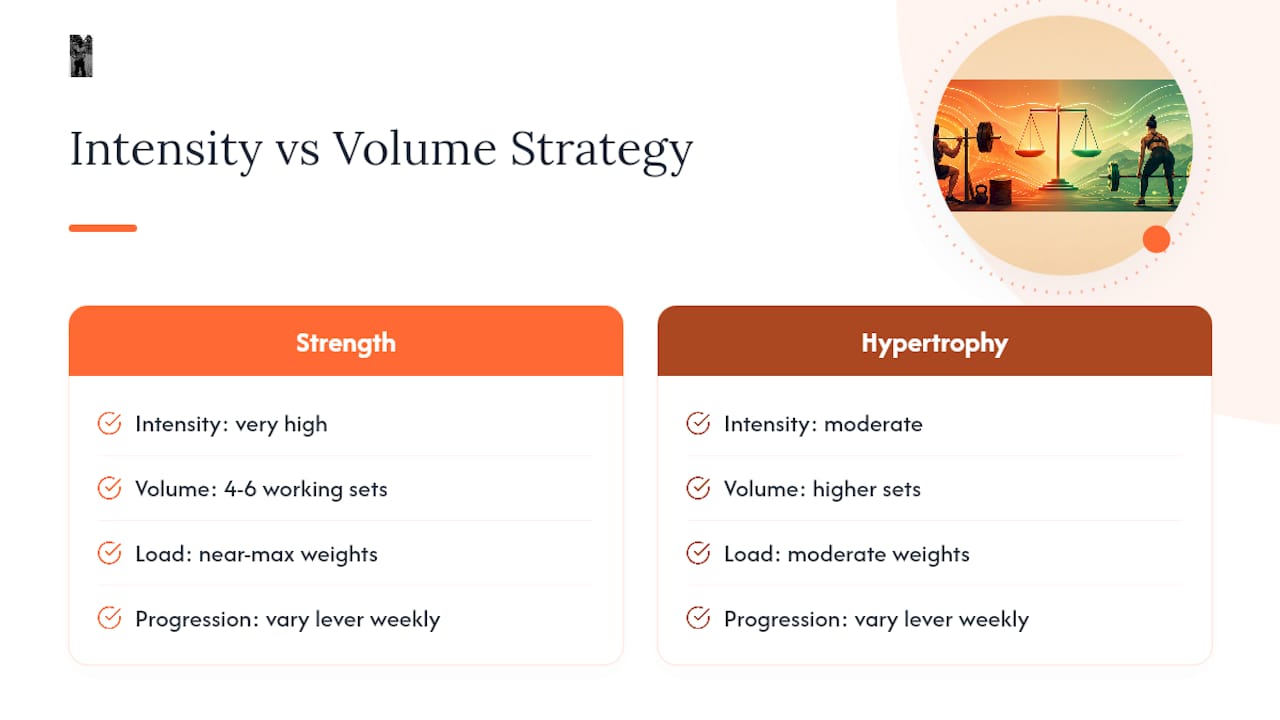
On strength-focused days, keep volume relatively low (4 to 6 total working sets per major lift) while pushing intensity close to your limits. On hypertrophy-focused days, keep loads moderate and let volume do the work instead. Trying to max out both intensity and volume on every single session across all four days is the single fastest route to a stall.
Track how you're recovering between sessions, not just within them. If your Thursday session feels noticeably harder than Monday's equivalent for the same weight and reps, that's fatigue accumulating faster than you're clearing it. Dropping one accessory exercise or trimming a set or two from each lift for a week is usually enough to reset before it becomes a bigger issue. A planned deload every 4 to 8 weeks, as covered earlier, handles the accumulated fatigue that builds even when week-to-week management is done well.
Why we default to upper/lower for most intermediate lifters
Upper/lower earns the default spot because it's the structure with the least room for error. Twice-weekly frequency is well supported, session length stays manageable, and it flexes easily toward strength or hypertrophy depending on how you load the reps.
PHUL and push/pull/legs-plus-one both have real merit, but they ask more of you: more attention to fatigue, more careful exercise selection, more room to accidentally undertrain something. Upper/lower forgives a slightly imperfect week in a way those structures don't.
Test it for six to eight weeks. Track your main lifts, note how you feel session to session, and be honest about whether you're actually completing all four sessions. That data will tell you more than any programme review ever could.
— prosper
Ready for a training plan built around your recovery and goals?
The templates above will move the needle if you run them consistently, but the biggest gap between a good 4-day split and a great one is individualisation. Fitprosperfitness builds custom 4-day programmes that adjust your set counts, exercise choices and rep ranges to your actual training age, recovery and schedule, rather than asking you to guess which generic template fits.

Every plan comes with a practical meal guide matched to your training days, plus monthly coaching so your programme changes when your progress or recovery does, not months later when you've already stalled. Whether you're moving up from a 3-day routine or refining an existing 4-day gym program, the process starts the same way: an assessment of where you are now and what's actually holding you back. Visit the Fitprosperfitness coaching page to see the available plans and start with a programme built around your numbers, not a generic template.